Hydrogen decarbonization
Engine cleaning by pure hydrogen injection, no disassembly, in one hour, from €99. Restores performance and reduces fuel consumption with no toxic discharge.
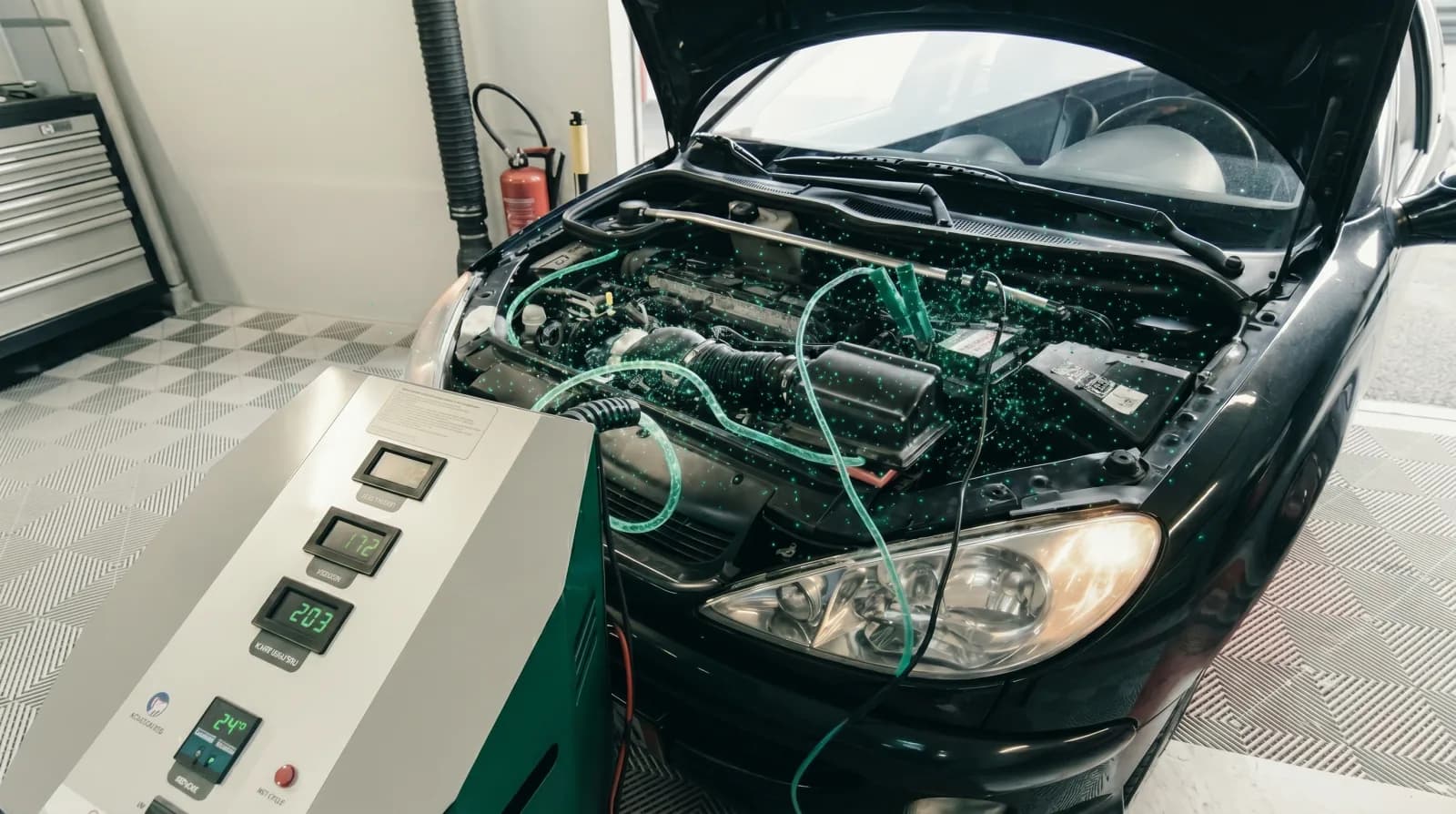
What is hydrogen decarbonization?
Hydrogen decarbonization is an internal engine cleaning process that uses pure hydrogen (H₂) injected at low pressure into the air intake. During combustion, the hydrogen raises the engine temperature and removes carbon deposits — the solid carbon accumulated on valves, in the combustion chamber, on the EGR system, the turbo, the particulate filter and the throttle body. The deposits are broken down and then naturally evacuated through the exhaust. The process applies to both diesel and petrol engines, with no disassembly or solvent, in an environmentally responsible way.
Quantified benefits
Typical figures measured on an urban-use diesel vehicle (≈ 100,000 km, frequent DPF regeneration) before and after a complete intervention.
| Before | After | |
|---|---|---|
| Average consumption | 7.2 L / 100 km | 6.5 L / 100 km |
| CO₂ emissions | 168 g / km | 152 g / km |
| Engine power | – 8 % | 100 % restored |
| Exhaust smoke (diesel) | visible | clearly reduced |
Observed benefits
On an engine fouled by urban use or a DPF that regenerates too frequently, hydrogen decarbonization delivers measurable results: a 5 to 10% reduction in fuel consumption, restoration of original engine power, an extended lifespan of the DPF, EGR, turbo and throttle body, and the removal of visible exhaust smoke on diesels. It is also one of the first reasons customers call: on a vehicle that has failed its inspection for excess pollution, decarbonization lets it pass the test in the vast majority of cases.
When is it needed?
Hydrogen decarbonization is particularly recommended for urban-use vehicles (traffic jams, short trips) that never reach operating temperature, for diesel engines whose DPF regenerates too often or whose warning light stays on, in case of progressive power loss, abnormal increase in fuel consumption, or before a vehicle inspection to pass the pollution test. Under normal use, a treatment every 30,000 to 50,000 km is enough to keep the engine clean. Under intensive urban use, the cycle shortens to 20,000 to 30,000 km.
Thefour-stepprocess
A clean, disassembly-free intervention in approximately 1h30
- 01
Electronic diagnosis
Reading of error codes, DPF and EGR status check. About 10 minutes. If the engine is not a relevant candidate, we tell you so without engaging the service.
- 02
Generator connection
The hydrogen generator is connected to the air intake via a suitable probe. The operation involves no disassembly and no mechanical contact with engine parts.
- 03
Decarbonization cycle
The engine first runs at idle, then we raise the revs in stages, up to 3,500–4,000 rpm, to reach the temperature that burns off the carbon in the combustion chamber and EGR system. Duration: about 1h30.
- 04
Post-treatment verification
Reading of codes after the treatment, visual inspection of the exhaust, validation of engine parameters. About 15 minutes.
Limits of the process
Hydrogen decarbonization is effective on moderate deposits. For very fouled engines (typically beyond 200,000 km, or never serviced since purchase), mechanical disassembly may still be necessary. The process cleans, it does not repair: it does not correct a structural mechanical fault (gaskets, piston rings, seized turbo, faulty oxygen sensor). Our preliminary diagnostic distinguishes what decarbonization can achieve from what requires a heavier intervention.
A safe and proven process
Hydrogen decarbonization has been used professionally in the automotive industry for over twenty years. The hydrogen concentration injected is far below explosive thresholds and the generator is electronically secured. The process is non-invasive: no disassembly, no mechanical intervention on the engine. This very non-invasiveness is what makes it both an ecological alternative and an economically reasonable one compared to traditional disassembly.
Frequently asked questions
Answers to the most common questions about Bioclean's hydrogen decarbonization.
No. The injection of hydrogen at very low concentration into the air intake gently breaks down carbon deposits with no mechanical contact with engine parts. Pressure and temperature stay within normal operating ranges. The process has been proven and used professionally for over twenty years.
Under normal use, every 30,000 to 50,000 km. Under intensive urban use (traffic jams, short trips), every 20,000 to 30,000 km. It is also good practice before a vehicle inspection to pass the pollution test.
Yes in most cases where failure is due to excess smoke (pollution test). Hydrogen decarbonization significantly reduces exhaust emissions. However, it does not correct mechanical faults such as a defective oxygen sensor or a faulty actuator.
Typically a 5 to 10% reduction in mixed-use consumption, and up to 15% on very fouled engines. The benefit is greater the more degraded the engine was before treatment.
About one hour in total: 10 minutes of preliminary electronic diagnosis, 45 minutes of decarbonization cycle at engine idle, and 15 minutes of post-treatment verification. The vehicle can be driven immediately afterwards.
Pricing
From €99
Preliminary diagnostic included. Total intervention time about one hour, at our La Ciotat workshop. Free loaner vehicle on site (subject to availability).
Or call us: 07 67 94 59 22 07 67 94 59 22
Available in these towns
All our services are carried out at our La Ciotat workshop, with a free loaner vehicle on site (subject to availability).