A/C recharge and pressure check
Air conditioning that no longer cools is losing its refrigerant — and making the compressor work dry. Pressure and tightness check with a manifold gauge, metered recharge with a new-generation, environmentally friendly and ozone-safe refrigerant (anti-leak additive included), then a cold test. Thirty-nine euros, around thirty minutes.
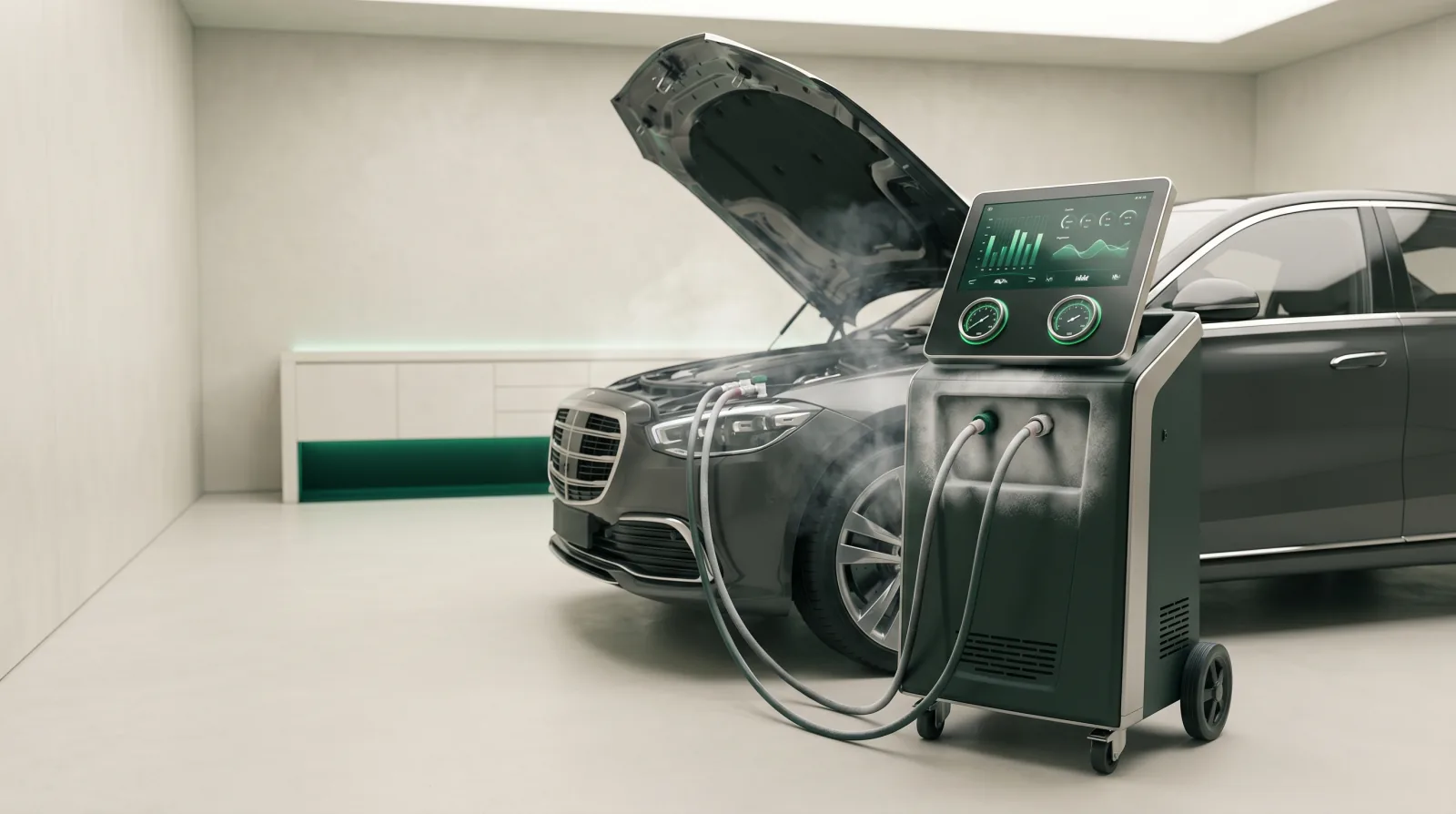
Restore the cold, protect the compressor
An air-conditioning circuit naturally loses some of its refrigerant every year, through micro-leaks at fittings and seals. When the charge becomes insufficient, the air turns lukewarm, the system labours, and above all the compressor — the most expensive part of the circuit — ends up running poorly lubricated, since the oil circulates with the refrigerant. A recharge is therefore not simply a matter of "adding gas": we first check the pressure and tightness of the circuit with a manifold gauge, then recharge it with the exact quantity specified by the manufacturer — a new-generation refrigerant, environmentally friendly and ozone-safe, equivalent to the original fluid for your vehicle — together with an anti-leak additive that treats the micro-leaks at the seals. A test of the air-outlet temperature validates the result.
- 01
Cooling restored for the long term
A charge brought back to the manufacturer's value restores the cabin's original cooling capacity. The air conditioning regains its efficiency, including in the full heat of a coastal summer.
- 02
The compressor protected
The refrigerant carries the oil that lubricates the compressor. A recharge metered to the right value prevents it from running dry — it is the most costly part of the circuit that is protected this way.
- 03
Micro-leaks treated
The pressure check with a manifold gauge reveals any abnormal loss, and the refrigerant we inject contains an anti-leak additive that seals the micro-leaks at the joints. In the event of a major leak, we tell you and guide you before any recharge.
Rechargeavehicle'sairconditioning
- 01
Pressure and tightness check
We connect the A/C station to the high- and low-pressure ports and read the pressures on a manifold gauge. This check identifies any abnormal loss before committing to the recharge — a circuit that does not hold pressure is flagged immediately.
- 02
Identifying the right refrigerant
We identify the refrigerant specified for your vehicle and prepare the recharge to the manufacturer's value. We use a new-generation refrigerant, environmentally friendly and ozone-safe.
- 03
Metered recharge with anti-leak additive
We inject the exact quantity of refrigerant specified by the manufacturer, with the associated lubricating oil and an anti-leak additive that treats the micro-leaks at the seals. Dosing to the right value governs efficiency and compressor longevity.
- 04
Air outlet temperature test
With the engine running and the air conditioning on, we measure the air temperature at the vents to validate the cold restored. The result is verified before the vehicle is returned.
- How do I know if my air conditioning needs a recharge?
- The most common sign is air that no longer cools, or that takes a long time to do so. A circuit naturally loses a little refrigerant each year through micro-leaks. If the cold weakens progressively from one summer to the next, a recharge is generally indicated. Our preliminary pressure check confirms the actual state of charge before any intervention.
- What refrigerant do you use for the recharge?
- We use a new-generation refrigerant, environmentally friendly and ozone-safe, equivalent to your vehicle's original fluid. We identify the one specified for your model and recharge to the exact quantity indicated by the manufacturer, with an anti-leak additive.
- Does the recharge treat small leaks?
- The refrigerant we inject contains an anti-leak additive that seals the micro-leaks at the joints, common on a circuit that is a few years old. The pressure check with a manifold gauge, carried out before the recharge, reveals larger losses: if the circuit does not hold pressure, we tell you before proceeding.
- How much does a recharge cost and how long does it take?
- An A/C recharge is charged at thirty-nine euros and takes around thirty minutes, including the check, recharge and cold test. Prices are inclusive of VAT. If the check reveals a major leak, we tell you: there would be no point recharging a circuit that does not retain the refrigerant.
- What happens if the circuit has a leak?
- Our preliminary tightness check reveals leaks before recharging. If the circuit has one, recharging without addressing it would have no lasting effect. We tell you clearly and point you towards the necessary repair. The recharge then takes place once the circuit is tight, for cooling that lasts over time.
Your air conditioning no longer cools as it used to?
Pressure check, metered recharge with anti-leak additive, cold test: thirty-nine euros, around thirty minutes. Workshop in La Ciotat, free loaner vehicle on site (subject to availability).
Or call us: 07 67 94 59 22 07 67 94 59 22
Available in these towns
All our services are carried out at our La Ciotat workshop, with a free loaner vehicle on site (subject to availability).