ECU engine remapping
Engine control unit map optimization to unlock power and torque. Flat €349 fee, 2-hour intervention. Service intended for off-road or track use, must be declared to your insurer.
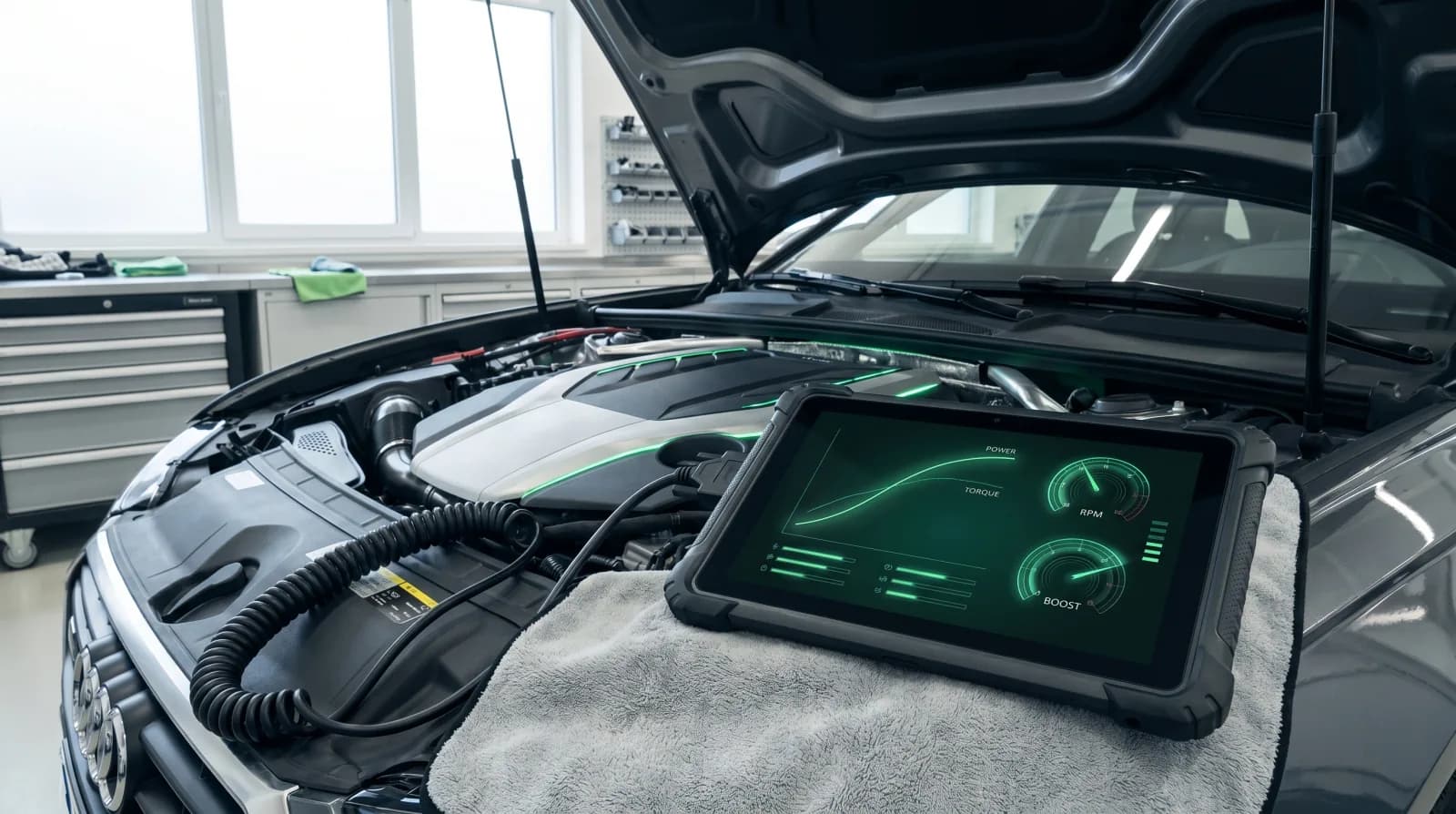
A service for specific use
ECU remapping alters the original engine map stored in your vehicle's control unit. It is intended for specific use (track, performance, off-road context) and must be declared to your insurer. It may result in partial loss of the manufacturer's warranty on engine and transmission components.
Before any work, we check with you the compatibility with your insurance contract and your real-world use of the vehicle. No service is undertaken without explicit agreement and signature of the detailed quote we provide you.
What is engine remapping?
Engine remapping — or ECU remap — consists of modifying the internal parameters of the electronic control unit that drives injection, ignition and, on turbocharged engines, boost pressure. As shipped from the factory, this map is deliberately conservative: the manufacturer leaves headroom to absorb fuel quality variations, international homologation standards and mechanical wear margins over the lifetime of the vehicle. By extracting that map, reworking it point by point and writing it back into the ECU, we release part of the performance reserve the engine can sustain without exceeding its mechanical tolerances. On certain TDI / HDI diesels, the same work can also improve part-load efficiency and slightly reduce fuel consumption under steady driving.
Typical observed gains
Ranges measured after a Stage 1 remap, depending on the original engine, its generation and its mechanical condition. Exact gains are contracted after diagnosis.
| Before | After | |
|---|---|---|
| Engine power | stock | + 10 to + 30 % |
| Engine torque | stock | + 15 to + 40 % |
| Turbo response | standard | sharper |
| Diesel fuel use (TDI / HDI) | stock | − 5 to − 10 % |
Observed benefits
A properly executed remap is felt immediately across the engine's everyday operating range: stronger part-load acceleration, torque available earlier in the rev range, noticeably sharper turbo response on forced-induction blocks. On modern direct-injection diesels, the work on the map can also translate into a measurable drop in steady-state fuel consumption, provided you keep a reasonable driving style after the intervention. The perceived benefit always depends on the starting condition of the engine — a fouled or poorly maintained block will not deliver its full potential, even after a remap.
Which vehicles and which uses?
Engine remapping primarily targets leisure vehicles, track preparations, sports vehicles and intensively used diesel commercial vans for which a torque gain has a functional purpose. It assumes a mechanically healthy engine: a worn-out, poorly maintained or internally leaking block cannot durably absorb a more aggressive map. For recent vehicles still under manufacturer warranty, we always perform a prior assessment of the contractual impact and we document the backup of the original map, allowing a full return to factory state if needed.
Afour-stepprocess
A rigorous, traceable and reversible protocol, completed in around two hours on-site or at the workshop.
- 01
Preliminary diagnostic
Reading of error codes, check of the engine's general condition, verification of critical parameters (boost pressure, airflow, temperatures). If the engine is not in healthy condition, the intervention is postponed and flagged.
- 02
Extraction of the original map
ECU reading via the OBD-II port or on the bench depending on the controller. The original map is fully backed up to allow a return to factory state at any time.
- 03
Optimized map development
Point-by-point rewriting of the injection, ignition and boost pressure tables to match the engine, its generation and the gain target agreed with you. Conservative safety margins are kept on every critical parameter.
- 04
Flash and real-time verification
Writing of the new map into the ECU, then immediate real-time parameter check and a road test to validate engine behaviour. The vehicle is handed back ready to drive.
Limits and precautions
Engine remapping does not create performance where the mechanics cannot absorb it: end-of-life turbo, marginal clutch, fragile gearbox, undersized brakes. Before any remap, we ask for a service history and inspect the components that will be stressed by the additional torque. We do not perform Stage 2 or higher without prior mechanical upgrades (intercooler, exhaust line, reinforced clutch). The service stays outside the perimeter of standard road use: it is the client's responsibility to ensure that their insurance contract and the actual use of the vehicle are compatible with the modification.
Frequently asked questions
Answers to the most common questions about Bioclean's ECU remapping.
A tuning box sits between certain sensors and the ECU to fool the controller: the original map stays in place, but the engine receives modified information. A remap, by contrast, directly alters the ECU's internal map, point by point. It is more precise, cleaner in the long run and fully reversible — but more committing on the insurance and warranty side. The two approaches do not target the same use: a box is a workaround, a remap is a commitment.
The modification must be declared to your insurer, who may either accept it (sometimes via an endorsement) or refuse to cover certain claims if it is not declared. On the manufacturer side, the warranty may be partly voided on the components directly stressed (engine, transmission). We systematically document the backup of the original map, which allows a full return to factory state before any dealer visit.
Yes, at any time. The original map is backed up during extraction and stays archived for as long as you remain our client. Restoring the factory map takes about thirty minutes and brings the ECU back to a state perfectly identical to its pre-intervention condition.
Vehicles with recent electronic management (post-2005), a healthy engine and up-to-date servicing are the best candidates. Modern turbocharged diesels (TDI, HDI, dCi, BlueHDi) deliver the most noticeable torque gains. Turbocharged petrols (TFSI, TSI, EcoBoost) respond very well in the relaunch range. Older naturally aspirated engines or end-of-life blocks will not gain much — we say so upfront if that is your case.
Flatprice
€349
Preliminary diagnostic, extraction and backup of the original map, development of the optimized map, flash and verification all included. 30 to 45-minute intervention on-site or at the workshop.
Or call us: 07 67 94 59 22 07 67 94 59 22
Available in these towns
All our services are carried out at our La Ciotat workshop, with a free loaner vehicle on site (subject to availability).